
LCD screens in 3D printing: Monochrome vs RGB?
You’re likely reading this article on a phone, tablet, or computer, and the first thing you notice is the screen 😉. In this article, we’ll thoroughly discuss two common types of LCD displays used in 3D printers in dentistry: monochrome and RGB.
LCD screens in 3D printing
In some 3D printers, especially resin-based ones, the LCD screen is a vital component. It determines which areas of the resin vat are exposed to UV light. Without the LCD, the only printable shape would be a flat rectangle stuck to the vat’s bottom.
The display’s resolution, determined by the number of pixels, directly impacts the print’s detail and surface smoothness. Smaller pixels result in higher resolution and finer details. However, the final print quality also depends on the materials used and the print settings, as we’ve discussed in other article.
Structure of Mono and RGB screens
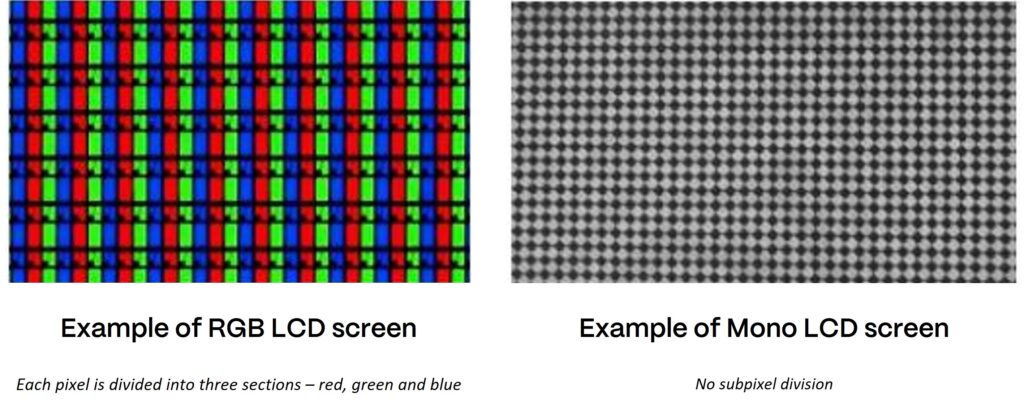
Take a look at the comparison graphic below, which shows an RGB screen (left) and a monochrome screen (right). RGB screens include color filters (Red, Green, and Blue), which are essential for devices like TVs, phones, and monitors. However, in 3D resin printing, color isn’t necessary. What matters is a single wavelength (or color) of light. For dental applications, this is typically UV light with a wavelength of 405 nm or 385 nm, which appears violet or bluish. Standard resins are designed to work with this light. The color filters in RGB screens reduce light transmission, similar to tinted windows, lowering the LED matrix’s output power. As a result, the resin curing process takes longer.
Lifespan of Mono and RGB LCD screens in 3D printing
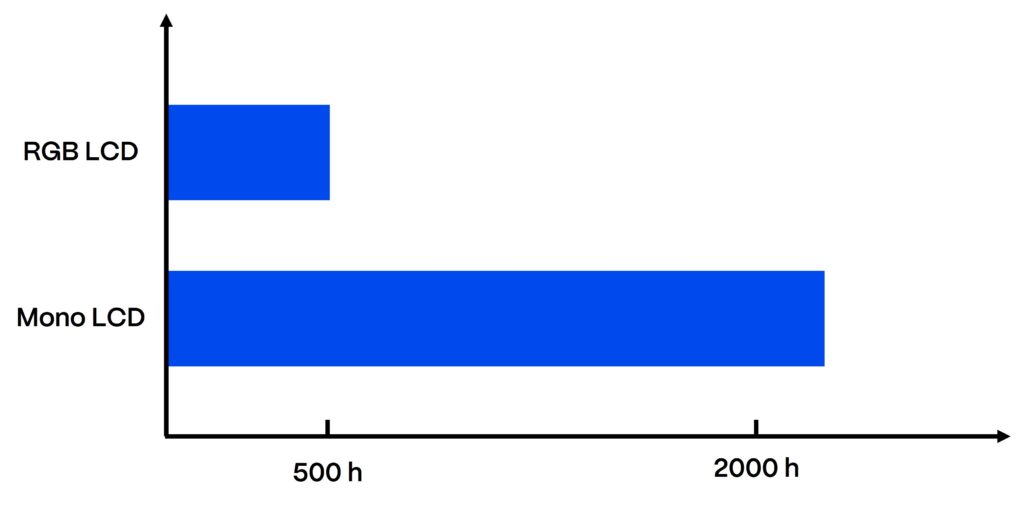
LCD screens in resin 3D printers are considered consumables. UV light damages them over time, so they must be replaced as their efficiency decreases. Unlike DLP systems, which can be recalibrated and continue functioning for many years, RGB LCD screens are not built to withstand prolonged UV exposure. Their lifespan is approximately 500 hours under normal use. Signs of wear include dead pixels, screen flickering, or reduced print quality. In contrast, monochrome LCD screens are advertised to last up to 2,000 hours, four times longer than RGB displays.
Monochrome LCD screens in 3D printing
Monochrome LCD printers are among the top choices for dental applications, producing reliable and detailed models such as dental casts, splints, surgical guides, and even crowns and bridges. The next step is simply selecting the appropriate materials for your specific needs.


Przemysław Grabowski
Challenges of 3D printing in low-temperature environments
When winter does not let up and temperatures drop not only outdoors, problems with 3D [...]

Kacper Włodarek
Dental 3D Printing: Accuracy vs. Resolution
When it comes to 3D printing applications in dentistry, accuracy is everything. It ensures that [...]

Kacper Włodarek
Choosing the Best Dental 3D Printer Technology: SLA, DLP, or LCD?
The world of dental technology is evolving rapidly, with 3D printing now a key part [...]
